Bluehost VS DreamHost
Bluehost vs DeamHost: Which One is Best for You?
If you’re new to the world of website building and hosting, or even if you’re a seasoned techie just looking to switch providers, the search to find the best hosting service can seem daunting. With so many options available, it can be hard to decide on just one.
You want the best for your site, and so do we! That’s why we took two of the biggest hosting providers, Bluehost, and DreamHost, and did some in-depth research to see which is actually the better option.
At first glance, these two providers seem very similar in terms of what they offer. Overall though, Bluehost came up the winner over DreamHost, with stronger features and better value for money.
Both are extremely strong though, hosting millions of websites across the globe, so you’ll be in good hands whichever one you choose. If you’d like to know more and really get to grips with these two providers, check out our in-depth reviews:
Bluehost or DreamHost: Which is Better?

Bluehost can be a godsend for WordPress novices and experts, and those would want a highly affordable hosting plan. It has a clearly organized dashboard with excellent customer support and several great features.
No wonder it’s one of three sites recommended by WordPress itself. If this sounds like your wishlist, make sure you sign up for a free trial with Bluehost.


Bluehost is another feature-rich hosting company that powers over two million websites across the globe. Owned by the global corporation Endurance International Group (EIG), Bluehost has much to offer, including shared and managed WordPress hosting.
Customers can choose from one of four shared hosting plans, with all plans incorporating the following features…
- Free domain name (for the first year)
- Free SSL certificate
- Automatic WordPress updates
- One-click WordPress install
- Unmetered bandwidth
- Website staging environment
- cPanel access
- 24/7 support
Apart from the low-tier Basic plan, all Bluehost shared hosting packages allow users to host an unlimited number of websites, and provide unlimited SSD storage, as well as unmetered bandwidth.
DreamHost features
- Free domain name (for one year if you sign up for a 12-month plan)
- Unmetered bandwidth
- WordPress pre-installed
- Automatic WordPress updates
- WP website builder
- Free SSL certificate
- Automatic daily backups
- 100% uptime guarantee
- 24/7 Support

DreamHost vs Bluehost: Comparison
What Types of Hosting Plans are Offered?
- Bluehost has a range of dedicated hosting plans with 4 cores, and up to and 1 TB storage.
- DreamHost offers 9 dedicated hosting plans with 4-core or 12-core processors, up to 64 GB of RAM, and up to 2TB HDD storage or 240 GB SSD storage.
- Bluehost has a few cloud hosting plans, with the highest plan offering unmetered storage space. Their cloud plans start at $9.99/month for 2GB of RAM and 100 GB of storage.
- Dreamhost’s cloud hosting packages start at $4.50/month ($0.0075/hour) for 100 GB Block Storage and 80 GB SSD (solid-state drive) disk space.
- DreamHost does not offer specific reseller plans, but you can add your client’s domains to your account and bill your clients.
- Bluehost offers different reseller plans, through Reseller Club. All come with support for unlimited websites and cPanel accounts.


PROMOTIONAL RATES
The prices listed above are the promotional rates, and, at the time of writing, they were the lowest prices you could pay when purchasing a new plan from DreamHost or Bluehost and paying for 36 months of hosting upfront.
If you prepay for less than three years, your hosting fees will be higher, depending on the length of your contract. Also, when the period of hosting you’ve paid for upfront is over, you’ll pay a higher rate to renew your plan.

As the renewal rates can be quite a bit higher than the promotional rates, be sure to take them into account when deciding which plan you can afford.
The Bluehost website has full details of their regular rates, but the renewal rates of the DreamHost plans aren’t as clearly published. Currently, though, the price of the DreamHost plans goes up to $11.99 a month, depending on which one you choose and how long you pay in advance.

Considering the top-level Shared Unlimited plan from DreamHost isn’t much more than the price of the entry-level Basic plan from Bluehost, DreamHost looks like the best value option here. However, don’t make a decision just yet, as there’s more to consider than price when deciding whether Bluehost or DreamHost is the right shared host for you.
Is Bluehost or DreamHost easier to use?
Choosing a host that offers a user-friendly experience is important. An easy-to-use hosting service will help to streamline your website setup process, enable you to easily access any tools and features that you may need, and support you in ensuring your website is functioning at its optimal capacity.
Luckily, DreamHost vs Bluehost have both spent time perfecting their hosting dashboards, control panels, and WordPress install processes to ensure that their services are user-friendly.
DreamHost user experience
DreamHost has a quick sign-up process and once your account has been created you can log into your DreamHost control panel.
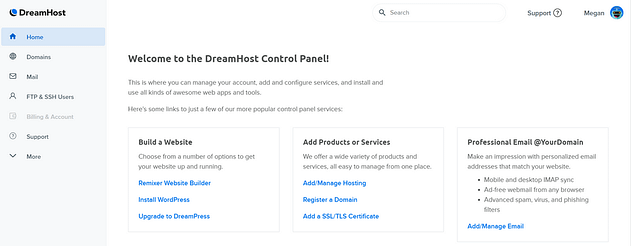
DreamHost built their own custom dashboard, rather than relying on cPanel like Bluehost.
It provides access to all your account, domain, and hosting information. You can also create new websites, configure website settings and features, access website databases and files, and much more.
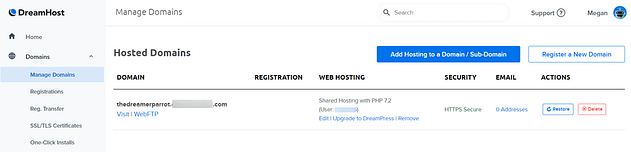
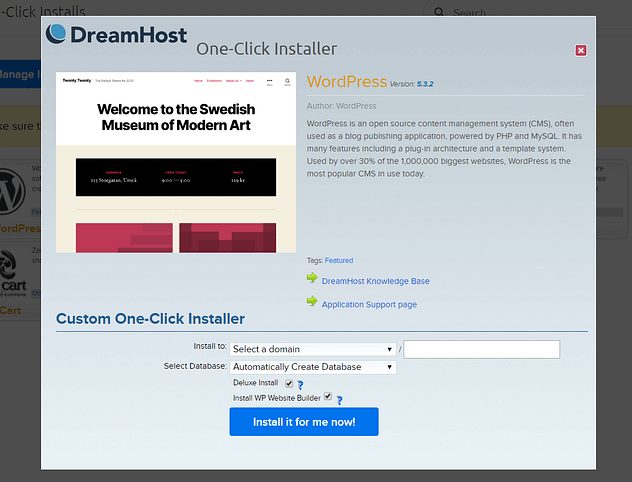
DreamHost will install WordPress for you in just one click. However, in my experience, installation isn’t immediate, and you may have to wait up to 10 minutes for an email announcing that your new website is ready to go.
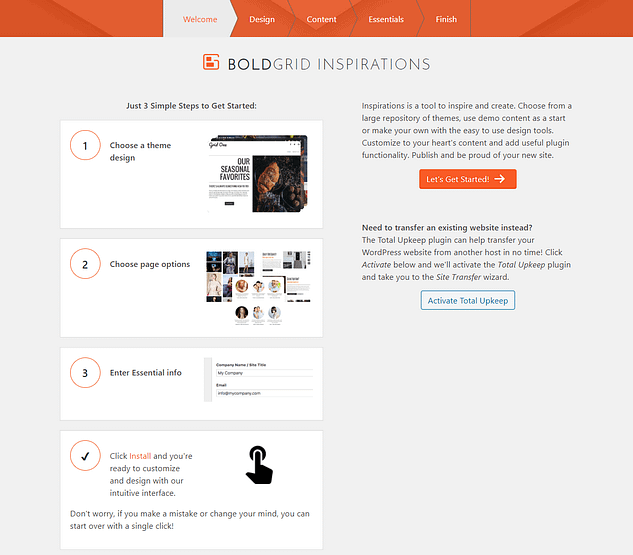
The DreamHost Start-Up Wizard walks users through the website setup process. It will help you choose a theme, create pages, and enter the essential information.
You can also just build your site from scratch using the regular WordPress dashboard.
Bluehost user experience
Bluehost offers a slightly more beginner-friendly user experience than DreamHost, with a cleaner interface that helps make navigating around the tools and services a quicker and easier process.
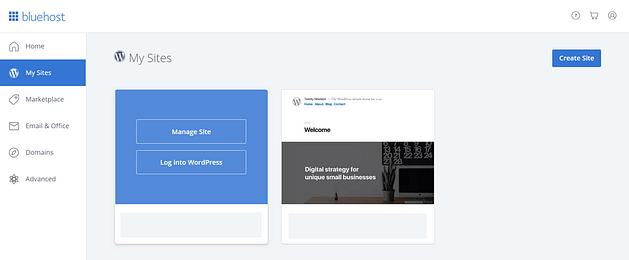
The Bluehost dashboard is easy on the eye, and its menu on the left-hand side of the screen enables you to immediately access any features or information that you might need.
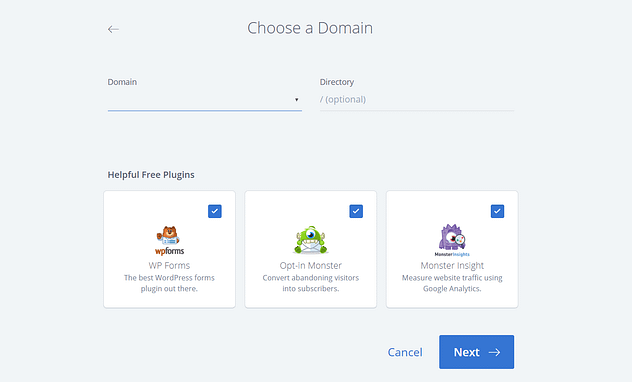
Bluehost offers a one-click WordPress install, automatically installing and setting up WordPress for you once you have selected a domain.
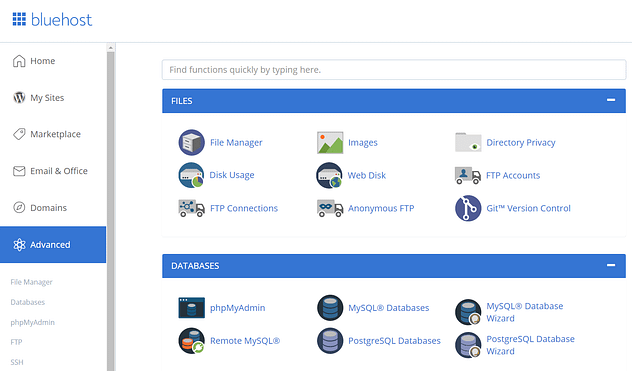
Bluehost also uses cPanel, giving you extra control over your website’s files, databases, and other functionality.
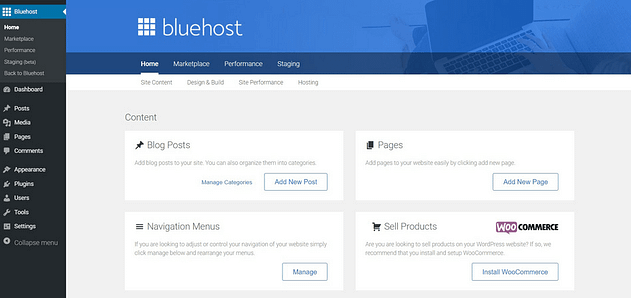
When Bluehost installs WordPress, it also installs its own Bluehost menu. This is a great option for beginners who may find the WordPress setup confusing or intimidating.
Within the Bluehost menu, you can easily create pages and posts, manage menus, install themes and plugins, create a staging area, and much more.
Overall, Bluehost is a user-friendly hosting provider and, in my opinion, it definitely has the edge over the user experience offered by DreamHost.
Which provider scores higher on performance tests?
The performance of your hosting provider is paramount, as poor performance directly impacts your visitors’ experience. Poor loading times can cause visitors to leave your website and not return, ultimately preventing your site from achieving its goals and costing you in leads and revenue.
For this article, we created two test websites with brand new WordPress installations – one hosted with Bluehost and the other with DreamHost. We then put them through vigorous speed tests using Pingdom to compare DreamHost vs Bluehost performance:
DreamHost
- USA (Seattle) – 0.73 s

- Canada – 0.99 s
- Germany – 2.06 s
- Australia – 1.80 s
Bluehost
- USA (Seattle) – 1.66 s
- Canada – 1.79 s
- Germany -2.13 s
- Australia – 2.25 s
From these test results, DreamHost shows itself to be much faster than the two hosts. Although Bluehost provides pretty average loading times, the times reported for the DreamHost hosted website are impressive.
USER SUPPORT
You can contact the support staff at both hosts via live chat 24/7, and, during testing for this comparison, both hosts were responsive and helpful via this channel. However, as I didn’t run into any major problems, and my interactions were mainly regarding queries I had about the service, I can’t say how good either host would be in a crisis.
As well as live chat, Bluehost will also let you call the help desk via their US and international telephone numbers. DreamHost only gives you the option of requesting a call back from the support staff. Furthermore, you have to pay to request a callback, with prices starting at $9.95.
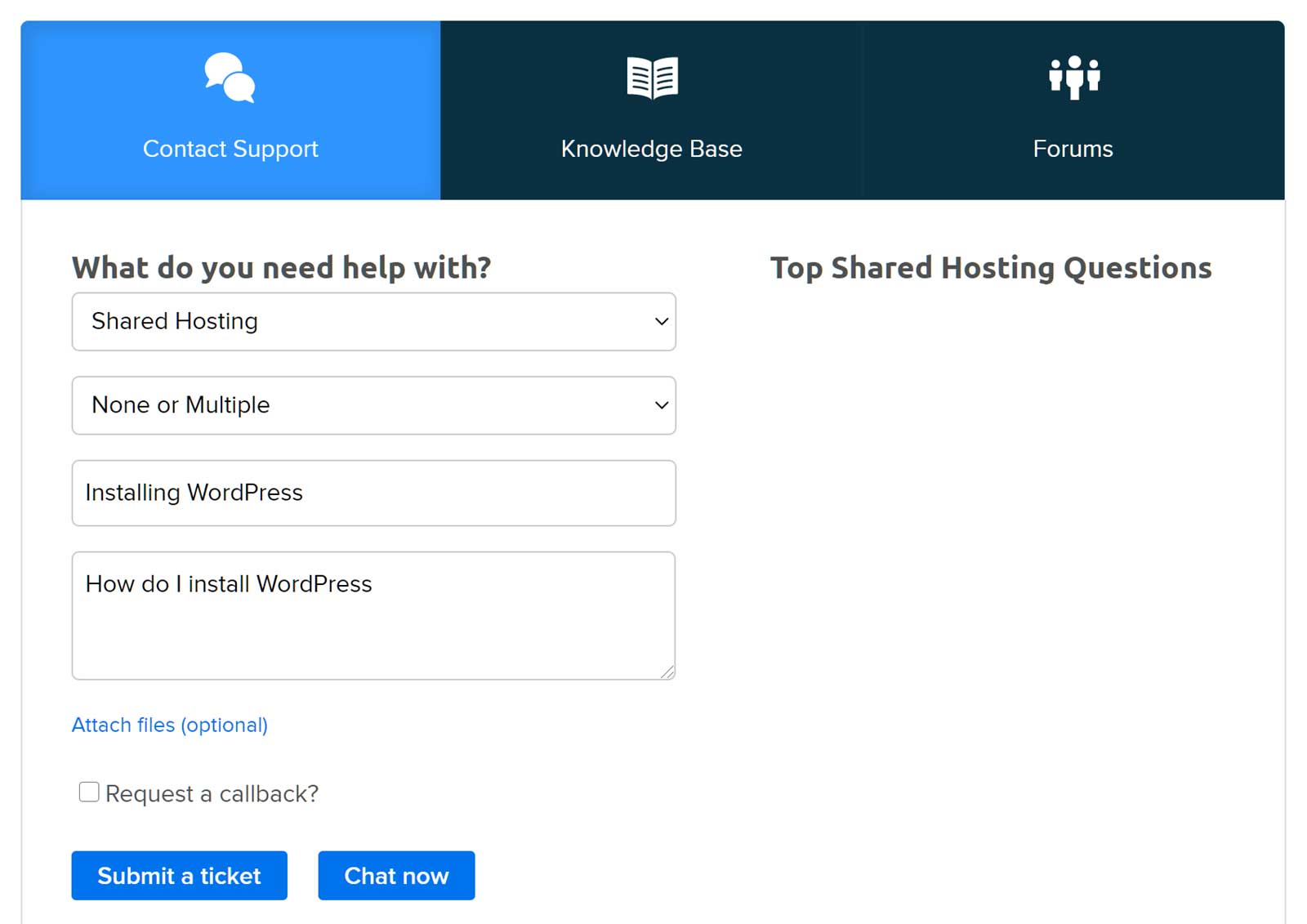
Unlike Bluehost, DreamHost does give you the option of submitting a ticket. They also make it easy to access the logs of previous live chat sessions through your account area. There’s a DreamHost discussion forum, too.
If you plan to use WordPress and would like extra help, you may be interested in the Bluehost BlueSky premium support service. Another option is to sign up with a third-party WordPress maintenance service if you’d like someone to take care of looking after your site.
Verdict: If you want to be able to contact support via telephone, and don’t want to pay extra for it, Bluehost is the winner. However, if being able to submit tickets to the help desk is more important, DreamHost is likely to be the better option for you.
Now that I’ve covered and compared the main features of the Bluehost and DreamHost shared hosting plans, it’s time to see what sort of performance you can expect from both hosts.
Bluehost vs DreamHost Shared Hosting Technical Details Overview
To answer any more questions you may have about the shared hosting from Bluehost and DreamHost, here are some of the technical details of the plans:
- Website caching: For WordPress users, Bluehost provides an in-house Endurance Cache service, which has three levels of caching, while DreamHost recommends the popular WP Super Cache plugin. DreamHost shared plans use the OPCache engine for caching websites that use PHP, such as WordPress websites.
- Content Delivery Network (CDN): Both DreamHost and Bluehost support integration with the free and paid Cloudflare plans, as well as integration with other CDNs.
- PHP: You can choose from a range of PHP versions between 7.0 and 7.4 through a web interface with both hosts.
- HTTP/2.0: HTTP/2.0 is enabled on the Bluehost and DreamHost shared plans.
- SSL: Customers of both hosts can easily apply a free Let’s Encrypt SSL certificate, import their own certificate, or purchase a different certificate from Bluehost and DreamHost.
- SFTP: Both hosts let you access your webspace for uploading and editing files via Secure FTP.
- Server file manager: You can access your server space via a browser-based file manager with Bluehost and DreamHost.
- Database access: You can create and access databases with both hosts via phpMyAdmin through a browser.
- Email service: Bluehost shared hosting plans including an email service with webmail, POP3, and SMTP and support. The DreamHost Starter plan doesn’t include email repair but the Unlimited plan does. DreamHost Starter customers can add email to their plan for a small recurring fee.
- WordPress website management: Both hosts offer optional automatic WordPress software, plugin, and theme updates.
- Plugin restrictions: Neither host disallow the use of any plugins, unlike some managed WordPress hosts.
- Security measures: Both hosts monitor their networks for attacks as standard. They both also offer paid security add-ons (SiteLock from Bluehost and DreamShield from DreamHost) that include daily malware scans, automatic malware removal, and other security features.
- Post-hack clean-up services: The shared hosting Bluehost plans don’t include fixes for hacked sites, although the optional paid SiteLock add-on can help with this. DreamHost has a paid Hacked Site Repair service, and their DreamShield paid add-on can help with this, too.
- Data center locations: Bluehost only have one data center, which is located in Utah, western USA, whereas DreamHost has two US data centers, which are located in Virginia and Oregon.
- Staging sites: The Bluehost shared plans include access to a WordPress staging tool, but the DreamHost shared plans do not.
- WordPress website migration: Bluehost will migrate one WordPress website for free, while DreamHost charges a fee for this, but you also have the option of using their free migration plugin.
- Uptime checks and guarantee: Both hosts monitor their servers for downtime, but not individual customer websites. Bluehost, unlike many other web hosts, does not have an uptime guarantee, but DreamHost has a 100% uptime guarantee.
- Support channels: Both hosts offer 24/7 support via live chat on their shared hosting plans. With Bluehost, you can call the support staff directly, while with DreamHost you can pay to request a callback.
You can view all of the rest of the details of the shared hosting plans from these hosts on the Bluehost and DreamHost websites.
Final Thoughts
Bluehost and DreamHost certainly have some of the most affordable shared hosting plans available today.
It’s true these plans are lacking some of the features found elsewhere, such as no automatic backups from Bluehost (except on their more expensive shared plans) and no staging tool from DreamHost. However, they do include all of the essentials, such as a free domain name registration and a good set of WordPress-focused features.
However, the main difference between the two hosts can be seen in the performance tests.
The DreamHost shared hosting plans are cheaper than those from Bluehost and their load times are faster.
In fact, if you plan to use a heavyweight theme or build a complex website, Bluehost may just be too slow, with DreamHost being the only realistic option here.
When it comes to making a decision on which host to choose, unless one of the features Bluehost has that DreamHost doesn’t is a deal-breaker, such as telephone support or staging, then it makes sense to sign up with DreamHost. Not only will you save money, but you should also end up with a faster-loading website.
Comments
Post a Comment